Wednesday, February 28, 2007

background for "Iraq in Fragments"

Some comments on James Longley’s film “Iraq in Fragments”

Iraq in Fragments is an award-winning documentary by Seattle-based director James Longley, who spent two years filming in Iraq. Visually the film is striking, even beautiful. It also displays a philosophy that people in a country such as Iraq ought to speak for themselves. Thus the three “chapters of the movie have no narration, no one telling the audience what to think or how to feel.


In the first chapter, “Mohammed of Baghdad,” you hear the voice of an 11-year-old working in a mechanic’s shop and the voices of the men with whom Mohammed works.

And you see the casual brutality and humiliation that is part of Muhammed’s life (and probably the lives of everyone he knows).

In the second chapter, “Sadr’s South,” with remarkable access to the followers of the radical Shiite cleric Moqtada al-Sadr, Longley captures the images of an increasingly violent revolution and insurgency.

And in the final chapter, “Kurdish Spring,” he presents the images and voices of a Kurdish boy and his elderly father.

This technique of documentary filmmaking expects much of the audience. We are expected to sort out who the characters are, where they are, why they are saying what they say and act as they act. And remember, Longley distills more than 300 hours of film into the 97 minutes of “Iraq in Fragments.” The film’s website provides very thorough production notes: http://www.iraqinfragments.com/. And Longley gave a very long interview about the making of the film for the Seattle International Film Festival:
Some chronology might help. Longley decided to make a documentary about Iraq in the spring of 2002, when everyone expected the US to invade eventually. He made his first trip to Baghdad in September, 2002 … a few pre-invasion images are in the movie. In February of 2002, weeks before the invasion, he returned to Baghdad, but had to leave within a few weeks when his visa expired. This meant that when the US and its allies invaded March 20, Longley was watching on TV in Cairo. Shortly after the US military captured the city of Baghdad on April 9, Longley returned to Iraq, where he remained until April 2005.
The first chapter is filmed from his February 2003 visit until early 2004. The focus is a boy named Mohammed.

It is in a mixed working class Baghdad neighborhood (both Shia and Sunnis), although most of the grownups talking are probably Sunni (one complains that when they try to get work they are told to go to the headquarters of the Shia Dawa political party). Note the attitude the adults have about the Americans: how does Mohammed absorb these views? What else does he absorb from the adults he spends his time with? Note too how Saddam is discussed (and recall how Mohammed’s father died).

Through the summer of 2003, Longley says, he felt relatively secure. American soldiers often strolled on the streets without fear. Note the way children and adults view American troops and patrols during this time.

As summer and fall progressed, violence worsened as insurgents targeted American soldiers and the US employed heavier tactics to break the resistance. Eventually Western and Iraqi reporters became targets of violence and kidnapping, and fearing for his security Longley left Baghdad for the Shiite-populated south. In August of 2003 he visited the holy city of Najaf in the south, where he established contacts with the Shiite religious leader Moqtada al-Sadr.

From late January to September 2004 Longley spent most of his time in the predominantly Shia city of Nasiriyah, where he (relatively) freely filmed Sadr’s followers as they sought to establish their control over the city. The Sadrists were organizing for elections, which they expected to win; the US sought to postpone free elections for a year, until the situation had stabilized. The second chapter lacks the focus on individuals of the first and third chapters.

A supporter of Sadr, Sheik Aws al Khafaji, receives most attention. Longley films an amazing incident when Sadr’s followers rout street venders purportedly selling alcohol. Note the contrasts the blindfolded and beaten merchants draw between Saddam and the Sadrists.

Longley films scenes form Ashura, one of Shia Islam’s holiest celebrations. For some background of Shiites, their celebrations, and parallels with different strains of Christianity, see the article by Elias Mallon, “Shiite Muslims: The Party of Aly”:
Another dramatic scene if the battle of Kufa on April 4 2004. Spanish soldiers fired on Sadrist demonstrators, setting off months of fighting between Sadr’s supporters and coalition forces. Forty minutes into the fighting in Kufa Longley arrived by taxi. About a minute of the fighting in Kufa shown in “Iraq in Fragments” (a grainy section) was filmed by one of the demonstrators who was being shot at.

Don’t be confused by the young boy who frequently sings and shouts at rallies: it isn’t Mohammed from the first chapter.

As the Sadrists grew frustrated with the heavy losses they absorbed fighting the Americans, they lashed out at Longley, bringing him before a religious court on charges of filming where he shouldn’t. He got off without a beating or worse, but realized it was time to leave the south. In September 2004 Longley relocated to the Kurdish section of Iraq to the north, where he remained until April 2005.

In “Kurdistan” Longley set up camp in a place called Koretan, a village so small it’s not on many maps.

He was attracted by the brickmakers’ ovens, which use petroleum for fuel and belch out appallingly beautiful billows of black smoke. Note the attitudes toward the Americans expressed by the Kurds: why does it seem to differ form the Sunnis’ in Baghdad and the Sadrists in the south? January 30 2005 witnessed legislative elections for the Iraqis. Longley films a Kurdish polling place.

For good background on Iraq, the magazine Mother Jones has prepared a feature they call “Iraq 101”: everything Americans should have known before invading.

Sunday, February 18, 2007

"Ala al Tariq fi Amrika" (On the Road in America)

Bill d'Aquila asked about a Muslim version of "Road Rules." You can visit the production company's website for more information: for images; for a preview clip.


Here's an article about the program from Friday's Wall Street Journal.


"Public Diplomacy, TV-Style"


Three Arab men go "On the Road in America" for a Saudi-owned
TV network


BY MARTHA BAYLES


Friday, February 16, 2007


Americans hear a lot about Al-Jazeera, the Qatar-based news channel censured (and
praised) for airing anti-American views; and Al-Arabiya, its more moderate Saudi-owned rival. We also debate the merits of Al-Hurra, the U.S. government-funded channel that is struggling to find an audience in the Arab world. Now there's a new kid on the block: Layalina Productions, a Washington-based nonprofit that makes Arabic-language programs for broadcast on the most-watched TV channel in 22 Arab countries: MBC (the Saudi-owned Middle East Broadcasting Center).


Layalina is the brainchild of Richard M. Fairbanks, former ambassador-at-large under President Reagan. Its mission is to project a favorable but non-propagandistic image of America through entertainment as well as news. Surprisingly, this concept was initially hard to sell. Founded in 2002, Layalina boasts an advisory board that is a Who's Who of media, business and diplomacy (George H.W. Bush is its honorary chairman). But as Mr. Fairbanks recalls, "there was a disconnect: Potential donors in the U.S. kept saying, 'The Arabs will never put it on,' and MBC said, 'We would love to broadcast Arabic-language shows made in America. But Americans don't make any.' "


Now they do. Layalina's maiden effort, a 12-episode series called "Ala al Tariq fi Amrika" ("On the Road in America"), is in its fifth week on MBC. It is a "reality show," featuring real people coping with a real situation. The people are three young Arab men: Mohamed, a 27-year-old Jordanian doctor; Ali, a 22-year-old Egyptian; and Sanad, an 18-year-old Saudi studying in Dubai; and the situation is a road trip across America with a film crew that includes a 30-year-old Palestinian producer named Lara and a 40-ish Israeli-American cameraman named Guy.


Layalina chose the three Arab men in an audition that excluded women, because, vice president Leon Shahabian explained, many Arab viewers would object to seeing unmarried men and women traveling together. Yet Mr. Shahabian described producer Lara's presence as "calculated" and added that the same is true of Guy's: "Our thinking was, 'Let's hire this guy and see what happens.' " Part of what happens is fluff. The participants clown, MTV-style, while driving a limo through Manhattan, riding horses in Montana and surfing in Los Angeles. But beyond these fun-in-the-sun sequences, the show contains some all too real moments, as the visitors encounter not only a mix of Americans but also--significantly--one another.


Because this tour took place in the summer of 2006, the first notable encounter is between Palestinian Lara and Israeli-American Guy. Several of the Americans that the group meets--a congressman, a Catholic priest, a zydeco musician--offer platitudes about "breaking down stereotypes" and "going beyond political, cultural, and religious differences to celebrate our common humanity." And something like this happens between Lara and Guy, when their sniping about the war in southern Lebanon yields to a tentative, grudging rapport.


It's hard to know how this rapprochement is going over with Arab audiences. There are no Nielsen ratings in Arab markets. According to Mr. Shahabian, however, the participants are now celebrities in the region, much sought after for interviews and other media appearances. In part, this is because the four look good falling off a surfboard. Yet that's not all. As a foreign-service officer posted to an Arab country recently told me: "Arab youth are in a serious mood. They want to be entertained, of course, but even more, they want to debate and discuss."


To its credit--and in sharp contrast to most American "reality" shows--"On the Road" makes (a little) room for serious conversation, including some grappling with national stereotypes. For example, when the group visits the King Fahad Mosque in Los Angeles, an impressive edifice built entirely by Saudi money (and in that respect not typical of American mosques), an argument breaks out between Sanad and Ali. Sanad chides Ali for equating Muslims with Arabs, reminding him that "the Prophet never said 'the Arab world,' he always said 'the Muslim world.' "


Does Sanad, the better-educated Saudi, triumph over Ali, the ill-informed Egyptian, because this show is airing on a Saudi-owned channel? Not really. Sometimes Ali wins, as when he, Sanad and Lara debate whether wealth makes people shallow and self-absorbed.


The series has many episodes to go. So far, though, this conversation seems free-wheeling, open-ended and clearly enjoyable for the participants. And in terms of America's image, what matters is not who wins the debate but where it takes place. Without harping on "freedom and democracy," this program speaks volumes about the country that serves as its backdrop.


"On the Road" is funded by a grant from the Richard M. Fairbanks Foundation (established by the ambassador's father). For the foreseeable future, the other programs in production at Layalina--an animated children's show and a version of "60 Minutes"--must similarly rely on donations. As Mr. Shahabian explains, America-friendly Arabic-language programming is not at the moment a money maker: "The cost of this production (about $1.6 million) has been low, but we only get back about one percent from MBC."


Yet when it comes to improving America's image, profit cannot be the sole consideration. There's no lack of commercial American programming on Arab TV. MBC alone runs two channels that carry only U.S. films and TV shows. Headlining the schedule this week is "Pepper Dennis," a forgettable (and forgotten) Warner Bros. comedy about an ambitious female TV reporter. To American eyes, it offers little more than stale jokes about one-night stands, wives leaving their sexually inept husbands and married men hiring prostitutes to liven up their poker games. To Arab eyes, however, such material reinforces the impression--alluring to some, repellent to others--of America as a land of unbridled hedonism and materialism.


Unlike Russians and East Europeans in the Soviet era, Arabs today are not starved for stimulation from the West. On the contrary, they are glutted with it. That's where Layalina comes in. As an enlightening exploration of America, "On the Road" will never win the Tocqueville Award, or even the Borat Booby Prize. Yet as a living illustration of the mysterious, wonderful chemistry by which all sorts of people feel free to speak their minds when standing on American soil, it may deserve the Public Diplomacy Medal of Honor--a prize for which, truth to tell, there has been precious little competition lately.


Ms. Bayles teaches in the Boston College Honors Program and is a visiting fellow at the Aspen Institute Berlin. Carol Huang assisted with this article.


Here's a story form the New York Times (January 31 2007) that provides a bit more background about what goes on in the making of the series.


''On the Road in America'' looks, on first viewing, like the sort of television show that Al Jazeera and MTV might produce if they could be coaxed together in front of an editing terminal. A 12-part reality series, currently being broadcast throughout the Middle East, ''On the Road'' features a caravan of young, good-looking Arabs crisscrossing America on a mission to educate themselves and the people they encounter along the way.

In reality, its list of production credits reads more like the roster of the Iraq Study Group that reported its findings to President Bush in December. The co-chairmen of that bipartisan effort -- James A. Baker III and Lee H. Hamilton -- are on the board
of advisers of Layalina Productions, the nonprofit (and nonpartisan) group that made ''On the Road in America'' and licensed it to Middle East Broadcasting Center (MBC), an Arab satellite TV network. (MBC is the parent company of Al Arabiya, a news channel that is a rival of Al Jazeera.)

Also on the advisory panel of Layalina are a former president, George H. W. Bush (listed as honorary chairman of what is officially its board of counselors), and nearly a dozen prominent members of his and other administrations, both Republican and Democratic, including Henry A. Kissinger, Brent Scowcroft, Zbigniew Brzezinski, Samuel R. Berger and Lawrence S. Eagleburger. (Also on the panel is Don Hewitt, the founder and longtime executive producer of ''60 Minutes,'' who helped edit the pilot of ''On the Road in America.'')

This unlikely coalition of unpaid consultants -- whose principal role was to raise money and to knock on diplomatic doors -- has helped create a series primarily intended to reintroduce America to the Arab world through the eyes of three students (from Egypt, Saudi Arabia and Lebanon) and a Palestinian woman who serves both as a production assistant and translator.

(The show can currently be seen only in the Middle East, though its producers are seeking an American distributor.)

Implicit in the series's mission, if not spoken aloud, is a desire to correct whatever damage has been done to America's standing in the Middle East by the Iraq war and the nearly four-year American military presence in that country. But the production, financed mostly through foundations and without government help, also seeks to counter the image of America often conveyed to the Arab world via Hollywood: that of an arrogant, self-absorbed, bellicose nation.

''What appealed to me about this project,'' said Dr. Brzezinski, who was national security adviser in the Carter administration, ''is that it seemed to be addressed to a real need, namely conveying somehow the reality of American life -- its diversity, its fundamental tolerance, the kind of thing that is not always understood abroad, either by admirers or detractors of America.''

Asked why he had chosen to align himself with the project, Mr. Shultz, who served as secretary of state in the Reagan administration, said: ''One of the things we need to learn how to do much better is communicate with the world of Islam. We are, at this time, amateurish.''

Marc C. Ginsberg, the president of Layalina and an ambassador to Morocco during the Clinton administration, said he wanted ''On the Road'' to be a ''warts and all'' portrayal of both sides of the divide between the West and the Middle East, to say nothing of the factions within the Middle East itself.

In the first episode -- set in Washington and broadcast on MBC on Jan. 18 -- Ali Amr, 22, an Egyptian accounting student, discusses his initial impressions of the American people. ''You will tell me they are not responsible for Bush's policies,'' he says, ''and I will tell you that they are the ones who elected Bush, correct or not?''

This particular clip, in Arabic, was not included in the six-minute highlight reel sent to Layalina's board of advisers, including the first President Bush. But Mr. Ginsberg said that Mr. Bush and the other advisers were made aware that the production might contain criticism of the American government.

''We had no intention of offending him,'' Mr. Ginsberg said of Mr. Bush. ''But we don't want to edit the comments of the stars of these shows.''

Reached on Monday, a spokesman for the former president said he had no comment. Mr. Ginsberg said he had sent a copy of the same highlight reel to an aide to Karen Hughes, a close adviser to George W. Bush currently serving as an undersecretary of state. ''They want us to come over and do a briefing at the State Department,'' Mr. Ginsberg said.

Far more bracing than the participants' occasional comments about the current president, though, is the frank discussion throughout the series's first two episodes -- the second takes the participants from Washington to New York City -- about the long-frayed relations between Israel and many of its Arab neighbors.

''Israelis, I hate Israelis,'' Lara Abou Saifan, the series's production assistant, a Palestinian from Lebanon, says in Arabic after a radio news report of Israeli bombing of her country last summer. But this being an American-made series -- its creator and executive producer, Jerome Gary, produced the documentary ''Pumping Iron'' (1977) -- Ms. Abou Saifan quickly (within the span of that 24-minute episode) comes to temper her views, mainly through a back-and-forth with a cameraman, Guy Livneh, who turns out to be Israeli. ''You know, the Arab world thinks that Israel wants to conquer the Middle East,'' he says inside the production van. ''That's absurd, you know.'' Later Ms. Abou Saifan tells Mr. Livneh: ''I never, never, never, never imagined that I'd have this conversation with someone like you.''

Layalina was founded by Richard Fairbanks, a Mideast peace negotiator during the Reagan administration, in the aftermath of the 9/11 terrorism attacks, with the hope of using mass media to help soothe the rage on all sides. Mr. Fairbanks's foundation is also among the chief benefactors of ''On the Road in America.'' At about $1.8 million, the series's budget is relatively cheap by Hollywood standards, considering that the production hopscotched across America last summer, with stops in the Mississippi Delta for a lesson on poverty, Montana (hiking with cowgirls), as well as Washington (singing with a gospel choir and campaigning for mayoral candidates) and New York (visiting a bond trader and ground zero). In the final episodes Americans accompany the four back to the Middle East.

The producers are also moving ahead on several other projects aimed at an Arab audience. One is a situation comedy -- the working title is ''How's Your Arabic?'' -- about an Arab-American trying to teach Arabic to immigrants and F.B.I. agents at an American university. Another project is a one-hour, weekly news magazine that MBC is considering. Its working title is ''Al Saat,'' which roughly translates to ''One Hour,'' a name that is hardly surprising, considering Mr. Hewitt's role as a consultant. MBC executives say it is too early to know how much of the prime-time audience of its main channel, MBC 1 -- typically about 21 million viewers, including in Saudi Arabia, Egypt and Iraq -- has tuned in for the first two episodes of ''On the Road.''
But Mazen Hayek, group director of broadcasting for MBC, said MBC was immensely
proud of its association with the project.

''The most important thing in this series,'' he said in a telephone interview from MBC's headquarters in Dubai, ''is that it will help us overcome existing stereotypes among Americans and Arabs, through the interaction of the talent, and through the viewers seeing how the Americans dealt with those guys.''


We'll be discussing this and other aspects of "public diplomacy" in class.

Sunday, February 11, 2007

new and improved paper topics(s)

As discussed in class, we have changed the paper a bit, and extended the deadline a week to February 22 (when, by the way, we are meeting at the country club to hear Taner Akcam). Here is the new and improved paper topic. You have a choice of two options, one deals only with US policy toward Iran; the other with US policy toward Iran and Afghanistan (which would require you to skip ahead and also read Fisk's chapter 21 where he returns to the theme of Afghanistan.

Middle East Politics
Spring 2007
First Paper

Write a single 4 to 5 page essay that answers all the questions in either Option A or Option B below. Use plenty of reference to Fisk’s book, and to other sources. (Be scrupulously clear about your sources!)

Option A: In The Great War for Civilization, Robert Fisk is critical of America’s policies in Afghanistan and Iran. Explain what he believes the US did wrong in each country. Were the mistakes similar or different in the two cases? Why does he believe the United States did what it did, and what do you think he thinks the US should have done differently? Do you agree or disagree? Why?

Option B: In The Great War for Civilization, Robert Fisk is critical of America’s policies toward Iran. Explain what he believes the US did wrong over the years. Why does he believe the United States did what it did, and what do you think he thinks the US should have done differently? Do you agree or disagree? Why?

This paper is due Thursday, February 22.

Wednesday, February 07, 2007

Map of Iraq-Iran War


How many Iraqis and Iranians died for those red and green slivers of territory?

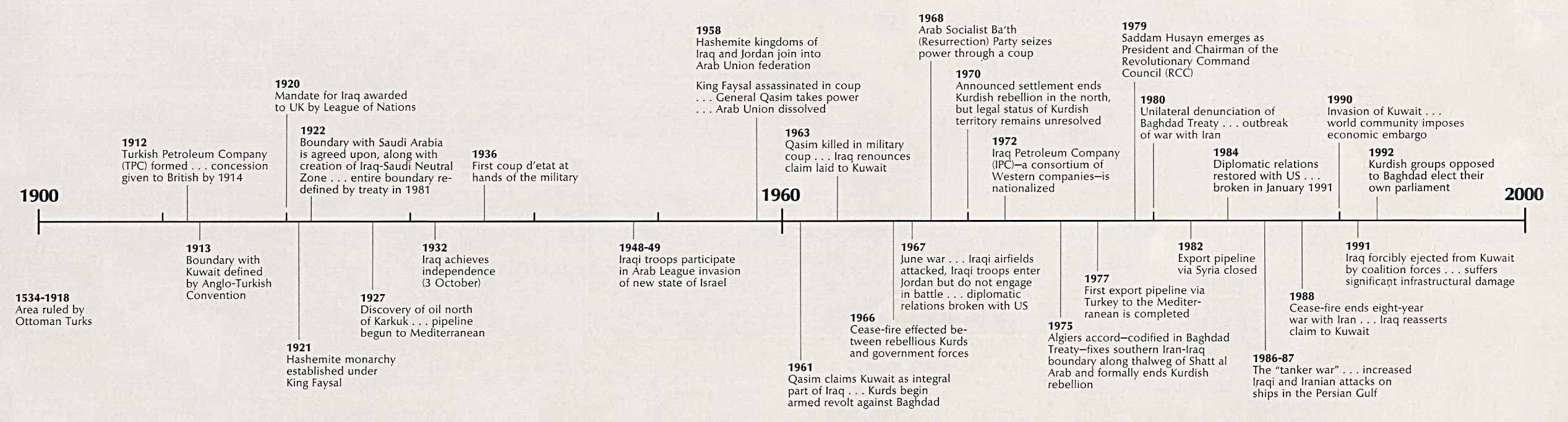
Iraqi timeline

I'll bet you can't read this:


But if you click here, maybe you can.

an exhibit by one of the most important photojournalists of the Mid East

I have been looking forward to this for a long time. If we can, perhaps we can get Foley to visit our class to show some of his work from the Middle East. See his website at http://www.billfoley.com/... his reception and talk at Marian Feb.22 will be a review-worthy event for our class.


Photojournalist Bill Foley will be showing his work in an exhibition entitled "Portraits—Life Unstaged—Photographs by Bill Foley" from February 19 - March 2 at Marian College in the Fisher Hall Art Gallery. An artist’s reception with a public gallery talk will take place February 22 from 5 – 7 p.m.; the public gallery talk will begin at 5:30 p.m.


Foley is a Pulitzer Prize-winning photojournalist with 29 years of experience in news, creative, editorial, and corporate photography. His assignments have taken him to more than 47 countries, including the Middle East and Eastern Europe, where he documented the conflict and human tragedy of those areas from the late 1970s until present. His work has been published in major newspapers, magazines, and books, and shown in numerous exhibitions worldwide. His photographs are held in a number of private collections. He is a leading photojournalist and sought after for lectures and workshops, teaching the power and potential of photography.


He will begin teaching at Marian College in the fall of 2007. For five years he was an adjunct professor at New York University in the Tisch School of the Arts. Now living in Indianapolis, Foley continues to work for a number of non-profit organizations and corporate clients, in addition to magazine assignments, and returns to New York regularly for select clients.


This exhibition is made possible by a grant from the Indiana Artist Craftsman, Inc.
For more information, contact Jamie Higgs, assistant professor of art and art history, at 317.955.6432 or jhiggs@marian.edu or Indiana Artist-Craftsman Association at 317.885.9517.

A question from one of your classmates

This question about the paper comes from one of your classmates. I would like to encourage you to talk to each other about the papers, so I am posting it here. My simple answer is that you should be able to tell some of his views about US policies toward Iran pretty easily from chapters 4-6 (hint: Mossadeq, Iraq's chemical weapons); what he thinks of US policy in Afghanistan in the 1980s is more subtle, you may have to work harder to tease it out.
I just want to be clear about what I am supposed to write about and where I will be getting the informatioin from. I am up to date on the reading of all 5 chapters in the Fisk book. From the reading of the first 5 chapters there are times in each chapter that Fisk will make comments about America or the current administration. Maybe I have forgotten some of what I have read but I don't recall him speaking directly about Afghanistan and Iran and America's policies. I guess my question is from the 5 questions that you would like for us to answer are you saying that I will be able to get my information from the first5 chapters? I know that you also gave us a blog to use as a source (Middle East Reading Notes Blog). Also, when you say that Fisk iscritical of Americas policies are you talking about the 2001 War inAfghanistan and the Iran-Iraq war? As you can see I am confused and Ijust want to be clear, could you please direct me in the right direction?

Perhaps it will help if I post a couple of background articles about Afghanistan in the 1980s to give context to what Fisk is saying. Stand by...

Sunday, February 04, 2007

From Gwyneth: what do you think?

Words from Gwyneth, post your comments!

  1. Relating to the comment about 'herdsmen work ethic" from the last class, there is also the cutural aspect of whether or not someone belongs to a future/present/past oriented society. We are very future oriented andnever live in the present, much of Africa is present oriented not feverishly persuing change like we do because this is how things are supposed to be/have always been, Eastern cultures are often past centered focusing on ancestors or past lives. This is a huge over-simplification, but this aspect of culture certainly impacts how well different cultures can worktogether on projects.
  2. NPR "All things considered" 2/3/07 talked about new legislation in Afghanistan to forgive those involved in violence in the past including the muhajedin and taliban http://www.npr.org/templates/story/story.php?storyId=7149284
  3. I belong to a internet group of professional interculturalists that often discuss issues such as differences between arab culture and musilm culture. Recent discussions have been about Iran and differences among cultures in asking for or giving help. Do people in one culture expect others to notice their need and offer help, therefore they do not solicitit, or is it your own responsibilty to ask for help if you need it? This relates to stronger nations, entities, companies, etc. stepping in in the middle east. The members write in from all over the world, so it is a great place to ask questions or just search archives of discussions. http://finance.groups.yahoo.com/group/interculturalinsights/

Good suggestions, Gwyneth. I've applied to join the group she mentions, we'll see what it's like. Thanks again, Gwyneth.

Friday, February 02, 2007

First paper topic

Middle East Politics
Spring 2007
First Paper

Write a single 4 to 5 page essay that answers all the questions below. Use plenty of reference to Fisk’s book, and to other sources. (Be scrupulously clear about your sources!)

In The Great War for Civilization, Robert Fisk is critical of America’s policies in Afghanistan and Iran. Explain what he believes the US did wrong in each country. Were the mistakes similar or different in the two cases? Why does he believe the United States did what it did, and what do you think he thinks the US should have done differently? Do you agree or disagree? Why?

This paper is due Thursday, February 15.

Thursday, February 01, 2007

2nd take on Prof. Atlas's conference

January 31, 2007

"Tufts Conference Scrutinizes the War on Terror"

MEDFORD, Mass.-- Participants at a two-day conference on terrorism at Tufts University were in broad agreement that the "War on Terror" has been misconceived conceptually and, for the most part, poorly implemented operationally. In the process, we've lost sight of the real terrorist threat to America--Al-Qaeda.

The general consensus on Iraq was that the war has been misguided and bungled from the beginning. President Bush's "troop surge" was viewed with skepticism at best. None of the speakers believed there will be a "good" outcome for Iraq, only a series of negative possibilities ranging from "bad" to "worse."

The question is, "Do we get an F or a D- in Iraq?" asked Peter Bergen, the former CNN reporter who interviewed Osama bin Laden and has written extensively about Al-Qaeda. "We can't create democracy or prevent civil war in Iraq. Sending additional US military forces to Afghanistan would make a difference. But not in Iraq."

Bergen joined about 25 scholars, journalists and terrorism experts for "The 'War on Terrorism': Where Do We Stand?" Hosted by Tufts' Fares Center for Eastern Mediterranean Studies, the conference attracted an audience of over 400 professors, students, State and Defense Department officials and members of the general public.

The distinguished roster of speakers included suicide terrorism expert
Robert Pape of the University of Chicago; Fawaz Gerges and John Esposito, well-known scholars of Islam and radical
Islamist movements;
Cofer Black, former counter-terrorism director at the CIA and State Department and current vice chairman of Blackwater USA; and investigative journalist Seymour Hersh of The New Yorker.

Several common themes emerged over the two days of presentations and discussion. The US response to terrorism has been overly militarized, without serious public diplomacy, economic
assistance, or efforts to resolve the Israeli-Palestinian conflict. A few panelists commented that the US military, although superb in combat, is not the most effective tool for counter-terrorism. One terrorism expert lamented that, in the Bush administration, "the DOD is the 800 pound gorilla and everyone else is teeny mice."

All the panelists were in agreement that the invasion of Iraq has been a boon to the radical jihadist cause.
Richard Shultz, director of the Security Studies program at Tufts noted that the Iraq war "has given Al-Qaeda an opportunity to engage the 'far enemy' [the US] up close, and an opportunity to spawn the next generation of warriors." As Fawaz Gerges put it, "The same jihadists who denounced Al-Qaeda after 9/11 are now looking for ways to join the fight against the US in Iraq."

Robert Pape, author of Dying to Win: The Strategic Logic of Suicide Terrorism, has created a data set of every known instance of suicide terrorism anywhere in the world since 1980. His research suggests that the tactic of suicide bombing has a specific secular and strategic goal: to coerce a democratic state to withdraw its forces from territory prized by the perpetrator. Pape, who taught at the Air University for three years and is in regular contact with the defense and intelligence community in Washington, asserted that "military conquest to transform Muslim societies is likely to increase suicide terrorism. Democracy is not a panacea in Iraq so long as US combat forces remain there."

The panelists made two other important points to which the White House seems oblivious. First, the very concept of a "War on Terror" is highly problematic. Terrorism is a tactic that is available to all groups in conflict, and always will be. How can you wage a war--let alone "win" one--against a type of behavior?

Second, not all terrorists are alike. Most groups that employ terrorist tactics (the deliberate targeting of civilians) are deeply embedded in their societies and have nationalist grievances that are rational and can often be addressed by political means. Hamas, Hezbollah, Kashmiri and Chechen groups, the Sri Lankan Tamil Tigers and most of the Sunni insurgents in Iraq fit this type. Al-Qaeda, on the other hand, has a nihilistic, apocalyptic agenda that cannot be negotiated.

Reflecting the sentiments of many at the conference, MIT political scientist Stephen Van Evra observed that the US response to terrorism "has been an unfocused shotgun approach to all groups in the Middle East, rather than a rifle aimed at Al-Qaeda." John Esposito of Georgetown University argued that "we need to be able to distinguish between moderate and extremist Islamists," especially as more Islamist groups will be running for elections in the Muslim world.

Perhaps the most sobering theme that emerged from the conference is that US policy is unlikely to change under the current administration. Conferences like the one at Tufts, with well-respected experts on the Middle East, Islam, and terrorism from inside and outside academia--many of whom are in regular contact with the intelligence and defense communities--will likely have little to no influence on what the administration actually does in Iraq or in the "War on Terror." Nor will the views of Congress, our allies, or the American electorate.

Seymour Hersh put it most bluntly: "For the next two years, we have a government that will do what it wants to do. The president and vice president are immune and inured to criticism."

Pierre M. Atlas is an assistant professor of political science and director of the Franciscan Center for Global Studies at
Marian College.


Page Printed from:
at February 01, 2007

1st of Pierre Atlas's 2 takes on a terrorism conference

Some time soon (while it's still fresh in his memory) we will have Prof. Pierre Atlas of Marian College discuss his recent conference at Tufts on terrorism. He just wrote two articles about it, appended below (I have added the links). Good stuff. (Check out the comments to the Star.)

"Experts pessimistic about surge"
Indianapolis Star February 1, 2007


President Bush's troop surge in Iraq represents "a strategic mistake in the wrong direction," says Robert Pape, an expert on suicide terrorism at the University of Chicago.

Pape was one of about 25 scholars, journalists and terrorism specialists speaking at a two-day conference on the "War on Terrorism" that I attended at Tufts University last week. The diverse group of well-respected American and international experts offered a range of interpretations of the War on Terror and varied somewhat in their policy prescriptions. But there was far more agreement than disagreement and, by the end of the conference, a general consensus had emerged.

All panelists seemed to believe that the "War on Terror" has been poorly conceived and implemented by the Bush administration, and that we long ago lost sight of the true target: al-Qaida. As for the war in Iraq, it has been misguided and bungled from the beginning, and has become the best recruiting tool for global jihadists. None of the speakers believed there would be a "good" outcome for Iraq, only a set of potential outcomes ranging from "bad" to "worse."
That said, all the speakers agreed that a quick U.S. exit from Iraq would leave a dangerous vacuum, to be filled by intensified civil war, sectarian killings, and al-Qaida.
Peter Bergen, the former CNN correspondent who interviewed Osama bin Laden before 9/11, predicted, "total withdrawal from Iraq would be a disaster. It would give jihadists a mini-Afghanistan."

Fawaz Gerges, expert on radical Islamist groups at Sarah Lawrence College, lamented that, "I opposed the war from day one, and yet I'm terrified to see what would happen in Iraq if we just pulled out." His sentiments were echoed by many others at the conference.


Pape agrees that we can't simply abandon Iraq. But the author of Dying to Win: The Strategic Logic of Suicide Terrorism thinks President Bush's "new strategy" of a troop surge in Iraq is a bad idea. As he told me at Tufts, he has two concerns about Bush's plan, which will send 20,000 more troops into Baghdad with a new mission to go after the Shiite militias as well as Sunni insurgents. It will not only increase the propensity for suicide attacks from Sunni extremists, but also will risk alienating the 15 million-strong Shiite population, vastly expanding the potential pool of opposition to U.S. operations.
Pape, who taught Air Force officers at the Air University for three years and is in regular contact with the defense and intelligence community in Washington, predicts that suicide attacks against U.S. troops and Iraqis working for the Iraqi government will increase, not decrease, with the surge.
The University of Chicago political scientist has built a data set of every known instance of suicide terrorism anywhere in the world since 1980. At the conference he demonstrated empirically what most scholars who study Islam or the Middle East have long argued, namely that "the connection between suicide terrorism and Islamic extremism is misleading."
Indeed, the world's greatest perpetrator of suicide terrorist attacks is not al-Qaida or Hamas but the secular nationalist Tamil Tigers of Sri Lanka. Most of their bombers are Hindu, but as Professor Sumantra Bose of the London School of Economics noted, Roman Catholic Tamils are disproportionately represented among the "Black Tiger" suicide bombers.
Pape argues that the widely used tactic of suicide bombing has a specific secular and strategic goal: to coerce a democratic state to withdraw its forces from territory prized by the terrorists. He asserts that this "strategic logic" explanation accounts for 95 percent of all suicide attacks worldwide.
Sending more U.S. troops into the heart of the nationalist and sectarian conflict in Iraq is precisely the wrong thing to do, Pape insists, and suggests an alternative to the surge: "The U.S. should transfer responsibility for Iraq's security to Iraqi forces and engage in offshore balancing." Navy and Air Force components could be stationed offshore "to intervene when necessary -- not U.S. combat forces on the ground." The U.S. should use these forces to make sure no side in the civil war uses heavy weapons to commit massive atrocities, as the Serbs did in Bosnia.
"Don't cut and run," Pape said. "But don't stay and die, either."
Atlas is assistant professor of political science and director of the Franciscan Center for Global Studies at Marian College. Contact him at patlas@marian.edu.

Think tank assignment

Now take two think tanks, one from the Middle East, the other Western (probably American) specializing in the Middle East. Be prepared on Feb. 8 to tell the class what you think about them. Are they particularly ideological, and how so? Is their work academic and technical, or more for general readers? Do they seem to emphasize events or publications or something else? See if you can find where their funding comes from. Check other sources (e.g. Lexis-Nexis, Factiva) to see if they are discussed much in the news media.


Justin Baudoux
American Enterprise Institute
Al-Ahram Center for Political and Strategic Studies (Cairo)
************************************************************************************
Patrick Chambers
Aspen Institute's Middle East Strategy Group
Al-Urdun Al-Jadid Research Center (Jordan)
************************************************************************************
Justin Chan
Brookings Institution's Saban Center for Middle East Policy
Applied Research Institute — Jerusalem
************************************************************************************
Kalkidan Christian
Carnegie Endowment for International Peace
Arab Planning Institute
************************************************************************************
Whitney Christian
Cato Institute
BAGHDAD CENTER FOR ECONOMIC RESEARCH
************************************************************************************
Janelle Coleman
Center for Defense Information
Bahrain Center for Studies and Research
************************************************************************************
Patrick Curry
Center for Strategic and International Studies
Begin-Sadat Center for Strategic Studies, Bar-llan University
************************************************************************************
Bill D’Aquilla
Century Foundation on International Affairs
BUSINESS ETHICS CENTER OF JERUSALEM
************************************************************************************
Gul Farooqi
Chatham House (UK)
Center for Strategic Studies, University of Jordan
************************************************************************************
Jeremy Fickle
Council on Foreign Relations
Centre for Arab Unity Studies
************************************************************************************
Ian Fleming
Foreign Policy in Focus
Egyptian Center for Economic Studies
************************************************************************************
Tyler Gough
Foreign Policy Research Institute on Iraq
Egyptian Council on Foreign Affairs
************************************************************************************
Weston Gray
Foreign Policy Research Institute on Middle East
Gulf Research Center (Dubai)
************************************************************************************
Mary Kathryn Green
Foundation for Middle East Peace
Harry S. Truman Research Institute for the Advancement of Peace
************************************************************************************
Tamara Grimes
Freedom House
Ibn Khaldun Center for Development Studies (Egypt)
************************************************************************************
Abir Haque
Heritage Foundation
Institute for Palestine Studies (IPS)
************************************************************************************
Shala Harmon
Hudson Institute's Center for Middle East Policy
IRAQ INSTITUTE FOR ECONOMIC REFORM
************************************************************************************
Travae Johnson
Human Rights Watch
ISRAEL CENTER FOR SOCIAL AND ECONOMIC PROGRESS
************************************************************************************
Henry Mestetsky
Institute for Policy Studies: New Internationalism -- U.N. and the Middle East
Israel Democracy Institute (IDI) - Israel
************************************************************************************
Mike Mullennax
International Crisis Group
Israel/Palestine Center for Research and Information
************************************************************************************
Ryan Mullin
Israel Policy forum
Jaffee Center for Strategic Studies
************************************************************************************
Tamara Nelson
Jewish Institute for National Security Affairs
JERUSALEM INSTITUTE FOR MARKET STUDIES
************************************************************************************
Brandon Newerth
Middle East Forum
Kuwait Institute for Scientific Research
************************************************************************************
Christopher Paicely
Middle East Institute
Lebanese Center for Policy Studies
************************************************************************************
Courtney Patterson
Middle East Media Research Institute
Moshe Dayan Center for Middle Eastern and African Studies
************************************************************************************
Victoria Payne
Middle East Policy Council
Omani Centre for Investment Promotion and Export Development
************************************************************************************
Kevin Petty
Middle East Research and Information Project
Palestinian Academic Society for the Study of International Affairs
************************************************************************************
Nikki Richart
Nixon Center
Palestinian Center for Policy and Survey Research
************************************************************************************
Ben Schmitt
RAND Center for Middle East Public Policy (CMEPP)
René Moawad Foundation
************************************************************************************
Gordon Smith
Transparency International
Re’ut Institute
************************************************************************************
Jeremy Snyder
US Institute for Peace
Shalem Center
************************************************************************************
Amber St. Clair
Washington Institute for Near East Policy
Sharif Think Tank (Tehran, Iran)
************************************************************************************
Gwyneth Sutherlin
Washington Report On Middle East Affairs
Tami Steinmetz Center for Peace Research (TSC), Tel Aviv University
************************************************************************************

Iraq teach-in at Columbus IN Feb. 20

This will be a fun event, long but fun. Zaineb Istrabadi, Nazif Shahrani, and Art Farnsley are three of my favorite people.

North High School (Columbus IN) AP United States History presents a Teach-In about Iraq
Tuesday February 20, 2007
Judson Erne Auditorium

Session 1: The War in Iraq
9:30-11:06 am
Zaineb Istrabadi (Lecturer in Near Eastern Languages & Cultures, IU) and John Clark, Senior Fellow at the Sagamore Institute, Professor of Middle Eastern Politics at IUPUI

Session 2: The Role of Religion in War/ Islamic Fundamentalism
1:45-3:15 pm
Zaineb Istrabadi, John Clark, Art Farnsley (Professor of Religion, IUPUI/IUPUC), and Nazif Shahrani (Professor of Anthropology and Central Asian and Middle Eastern Studies, IU)

Session 3: The War in Iraq and Islamic Fundamentalism
7:00-9:00 pm
Zaineb Istrabadi, John Clark, Art Farnsley, Nazif Shahrani

Chairman: Katie Logan dgkjlogan@sbcglobal.net
Mr. Ed Niespodziani- 376-4237- niespodzianie@bcsc.k12.in.us

Wednesday, January 31, 2007

Some recent interesting articles about Iran

Dissent magazine asked a group of respected center-left experts on the Mid East thisset of questions about Iran:
For a quarter of a century, Iran has been ruled by a militant theocracy.
After the shah's regime--authoritarian, brutal, and backed by the United
States--was overthrown, the new regime quickly proved itself to be
authoritarian, cruel, and self-warranted by Islamic fundamentalism. Reform
efforts have proved chimerical, and Tehran has pursued nuclear capabilities with
vigor, long deceiving the International Atomic Energy Agency and Western
interlocutors about its efforts. To what extent should the character of the
Iranian regime govern Western responses to its ambitions? Should Iran be
considered just one state among others, seeking its legitimate self-interests?
What "threat" does the current Iranian regime pose in today's world? Responses
appear below.

You can read the articles here: http://www.dissentmagazine.org/issue/?issue=62

Dissent also has an address by former German Foreign Minister Joschka Fischer: http://www.dissentmagazine.org/article/?article=726


Here's a review of a book I haven't read, but hope to soon: Ray Takeyh, Hidden Iran: Paradox and Power in the Islamic Republic -- http://www.nationalinterest.org/Article.aspx?id=13292

Tuesday, January 30, 2007

Gen. Odom on Iraq, always worth reading


You remember my mention of Jimmy Carter's National Security Adviser, Zbigniew Brzezinski? His chief military adviser was William Odom, who went on to be head of the National Security Agency under Reagan. Odom was a colleague of mine at Hudson Institute, very bright and opinionated. Odom loudly opposed the invasion of Iraq from the beginning. It wasn't just that it was executed badly (too few troops, for instance, or inadequate planning). It was fated to be a strategic disaster from the moment US troops' boots touched Iraqi soil: it strengthens America's enemies, hurts our relations with our allies, and destabilizes a regions whose stability ought to be our primary goal. You can read Odom's testimony to the Senate last week here:


He may be mistaken about how to get out, but Odom always rewards reading.

Details about IU Bloomington Middle East Festival

A lot of excellent events if you are in Bloomington. This is from Çigdem Balim, who will be happy to answer any questions you have: cbalim@indiana.edu Review-worthy events for Middle East Politics are in red.


Annual Middle Eastern Arts Festival Feb 1st-10th

Contact: Department of Near Eastern Languages and Cultures, Middle Eastern and Islamic Studies Program102 Goodbody, 3rd St, Bloomington, IN 47404, 812-855-5993, Melissa Henige at nelcmesp@indiana.edu

The Annual Middle Eastern Arts Festival Feb 1st-10th celebrates Middle Eastern art, culture, and influence. Visit the event website at www.indiana.edu/~nelcmesp/arts for descriptions, dates, locations, etc. This year, theFestival will feature Middle Eastern art and ethnomusicology, art demonstrations, films, food tasting, folkdance, poetry, lectures, and much more. The sponsored events are free and open to the public. Attached is a sampling of the events to take place in the Bloomington community and on IU-B's campus. For addtional information call at 812*219*7684.

MIDDLE EASTERN ARTS FESTIVAL February 1st-10th!

Windfall Dancers, and Iraqi music group Salaam
When: Feb. 2nd, 3rd, 9th, and 10th at 8:00pm
Where: John Waldron Arts Center,122 S. Walnut St. http://www.artlives.org/

Windfall Dancers use modern dance as a narrative to tell the age-old stories of Arabian Nights. Iraqi music group, Salaam, performs with them. This show will be a magical event suitable for the entire family. Non-sponsored NELC event www.windfalldancers.org; www.salaamband.com

Tickets available by calling 812-334-0506, at 1101 N. Dunn St, or online at http://www.bloomingtonarts.info/

***********************************************************************************
Middle Eastern Book Exhibit
When: Feb 1st-18th 9AM-5PM
Where: IU-Fine Arts Library, 2nd floor 1133 E. 7th St,

A selection of Fine Arts Library books and facsimile editions of manuscripts on Middle Eastern arts and culture will be exhibited. Accompanying this exhibition will be a selection of artists' books by Buzz Spector, Chair, Department of Art, Cornell University.

http://www.indiana.edu/~iuam
Contact B. J. Kish Irvine, Fine Arts Librarian for more information 812-855-5445
Free

************************************************************************************
Persian Film: "The Twilight"
When: Feb 1st, 7-9pm
Where: Swain East 140, IUB campus

Come watch "The Twilight", directed by Mohammad Rasulof. The film presents an intense and stark portrait of life among the rural underclass and meditates on the meaning of freedom, as petty criminal, Reza, is released from prison after serving half of his life there.

Contact: plosensk@indiana.edu; sdaneshg@indiana.edu

************************************************************************************
Children's Spectacular
When: Sunday Feb 4th, 2-3pm
Where: Monroe Public County Library, 303 E. Kirkwood Ave, Library Auditorium

Children's comic program with folkdance, swordsman, and tales from the Middle East. The program has been designed specifically for children, though enjoyable for any age! Performers Katya Faris (http://www.katyafaris.com/) and Mohamed Shahin (http://www.mohamedshahin.com/) will dazzle you with their elaborate colorful costumes, dance, and music!

Free. For more information call 812-349-3100 or http://www.monroe.lib.in.us/

***********************************************************************************
Middle Eastern Cuisine Sunday

When: Sunday Feb 4th, 7pm
Where: Café Ragazzi, 212 S. Rogers

Middle Eastern Cuisine Sunday fills up quickly so please call for reservations for International Cuisine Sunday. Graduate student, Ahmad Almallah, and Café Ragazzi owner, Tamyra Dippolito, will present the cuisine and history of Palestine.

Call for reservations: 812-323-9005.

************************************************************************************
Internationally known contemporary artist Najjar Abdul Musawwir

When: Monday February 5, 7:00pm
Where: Foster International Center

Andrew Gipe

************************************************************************************
Middle East Art related lectures

When: Friday Feb. 9th, 2:30-5:30pm
Where: Lilly Library, 1200 E. 7th St.

Distinguished professors and graduate students of IU-Bloomington--Christiane Gruber, Yasmine Gencer, and Deborah Justice--will provide talks on Middle Eastern art and architecture. Light refreshments will be provided.

Free: 812-855-2452, http://www.indiana.edu/~liblilly/

************************************************************************************
Ethnomusicology Career Workshop

When: Feb. 9th, 7-9pm
Where: Mather's Museum of World Cultures, 416 N. Indiana. St

Irene Markoff, who is well-versed in Sufi music, having written her PhD dissertation on musical theory, performance and the professional baglama(folk lute),and specialist of Turkey. She will give a workshop on "The Challenges of Teaching Turkish Music in an Ensemble/Lecture Setting," as well as strategies and reflections on an ethnomusicology career. Light refreshments provided. Free, call 812-855-6873 for more information. Sponsored by the American Turkish Society.

************************************************************************************
Ethnomusicology Presentation and Performance by Irene Markoff

When: Saturday Feb 10th, 4-6pm
Where: IMU, Faculty Room of the University Club

Irene Markoff will give a talk on Sufi Music and Ritual in Turkey. The presentation will include a discussion on poetry, rituals, music, and the concepts of sama and zikr. Performance (baglama and voice) will be integrated into the presentation. Light refreshments provided. Sponsored by the American Turkish Society.

Monday, January 29, 2007

Suggested articles for history of Iran before Islamic Revolution

Shiva Balaghi, A Brief History of 20th-Century Iran

New York Times collection, Secrets of History: The CIA in Iran

Mostafa T. Zahrani, "The Coup That Changed the Middle East: Mossadeq v. The CIA in Retrospect"

Zehra F. Arat, "Democracy and Economic Development: Modernization Theory Revisited" (available through JSTOR)

You can read a good review of Steve Kinzer's book, All the Shah's Men: H. D. S. Greenway, "The Iran conspiracy," The New York Review of Books Volume 50, Number 14 September 25, 2003

the history you need for understanding Fisk chapter 4

The Past Century of Persian/Iranian History

A couple of books on Iran that I would recommend buying if you see them at Half Price Books (or order them used from Froogle):

Ken Pollack's The Persian Puzzle: The Conflict Between Iran and America.

Dilip Hiro, Iranian Labyrinth

David Harris,The Crisis: The President, the Prophet, and the Shah-1979 and the Coming of Militant Islam

Stephen Kinzer, All the Shah's Men: An American Coup and the Roots of Middle East Terror

Azar Nafisi Reading Lolita In Tehran: A Memoir In Books

1906: Constitutional Revolution establishes Iran's first Parliament. Iran (Persia) was in a position similar to other ancient autocracies confronting the West, how to modernize and thus prevent colonization, while still preserving its distinctive political and cultural identity. Compare it to Japan, Russia, Siam, Russia, Ethiopia. Persia at this time was subject to competition from Britain and Russia: replace Britain with the US halfway through the 20th century, and Russia with the Soviet Union ... and that is the situation until 1991. Neither Russia or Britain wanted a strong liberal Persia. And because it was locked in this competition between two great powers, Persia naturally looked outside for support, particularly to Germany.


1921 Military commander Reza Khan topples Ahmad Shah (1909) of the Qajar dynasty that had ruled for almost 150 years. The Brits and Russians had worked to subvert the constitutional republic, preferring a feeble monarchy. World War I hammered Persia's economy, and the country was fragmenting. Reza Khan sought to use the military to unify the country.

1925 Reza Khan names himself Shah of Iran, first of the Pahlavi dynasty. Big projects for the new Shah: a railroad connecting the pieces of the country, mass education outside of the control of the Shiite clergy, tax and legal reform, concentration of political power in his hands. Typical modernizing autocrat, try to impose his will on a backward country without allowing political power to become diffused.


1935 Country's name officially changes from Persia to Iran.

1941-1945 Although Iran declared its neutrality in WWII, the Allies believed Reza Khan sympathetic to Nazis and forced him to abdicate to his son Mohammad Reza. Allies use Iran as a supply line to Russia.


1951 Prime Minister Mohammad Mossadegh nationalizes oil industry. Britain retaliates with a trade embargo, leading to economic collapse.


1953 The Mossadegh government is overthrown in a CIA-British-backed coup; Mohammad Reza Shah, who had fled, returns to power.


    1963 The Shah begins the "White Revolution," an ambitious--and controversial-modernization program. Opponents are repressed.
      1979 the Shah is toppled in an Islamic revolution, establishing the Islamic Republic of Iran as a theocracy under the rule of Ayatollah Ruhollah Khomeini. Fifty-two Americans are taken hostage at the U.S. Embassy.


      1980 Attempted rescue of hostages fails; eight U.S servicemen die,

      1980 Iraq invades Iran, sparking an eight-year war that kills an estimated 500,000. America backs Iraq with military intelligence but supplies weapons to both sides.


    1981 American hostages are released after 444 days in captivity.


    1985 Secret arms deals conducted between the U.S. and Iran later becomes known as the Iran-Contra affair.


    1988 Iran and Iraq sign a cease-fire agreement.


    1995 Accusing Iran of sponsoring terrorism, the United States bans all trade with the nation.


    1997 Reformist Mohammad Khatami is elected president by a landslide.


    2000 Reformists win 70 percent of Parliament seats, Hard-line judiciary begins crackdown on newspaper editors and dissidents, leading to newspaper closures and arrests.


    2001 President Khatami is reelected in a landslide victory.


    2002 President George W, Bush lists Iran, together with North Korea and Iraq, as part of the "Axis of Evil"


    • 2004 Conservatives regain control of Parliament after thousands of reformist candidates are disqualified. The International Atomic Energy Agency (IAEA) rebukes Iran for failing to cooperate with nuclear inspections.


    • 2005 Iran allows IAEA inspections in January.


    From Afshin Molavi, "A new day in Iran?" Smithsonian Mar2005, Vol. 35 Issue 12, p54-63

    Elias Mallon's "Shiite Muslims--The Party of Aly"

    This is a good overview of the background of the Shiite/Sunni divide. Fr. Mallon is speaking at Marian College Feb. 8, try to see him.


    America, 2/6/2006, Vol. 194 Issue 4

    Fr. Elias Mallon


    "Shiite Muslims--The Party of Aly"


    Since the beginning of the war in Iraq on March 20, 2003, Americans have encountered Shiite Islam in the media more frequently than at any time since the taking of the hostages in Tehran, when the American Embassy in Iran was occupied on Nov. 4, 1979, and Americans were held hostage for 444 days. As the Iranian Revolution developed, many Americans who had barely heard of Shiite Islam became painfully aware of the Shiite term ayatollah. Indeed, until recently these Americans believed that Ruhollah Khomeini, the leader of the Iranian Revolution, was the ayatollah. In fact, he was not even the main ayatollah, much less the only one. Now Americans hear about Shiite Islam in every newscast and read about it almost every day in the newspapers.


    If most people in the West know little about Sunni Islam, which includes approximately 85 percent of all the Muslims in the world, knowledge about Shiite Islam is even more sparse and often entirely colored by the state of U.S. relations with the Islamic Republic of Iran. The memory of the hostage-taking in Teheran and media images of Shiites whipping themselves during the annual mourning for the death of Imam Hussein have produced the image that Shiite Muslims are fanatical and even bloodthirsty. Nothing could be further from the truth.


    The roots of Shiite Islam go back to the death of the Prophet Muhammad in June 632. Muhammad had left no instructions about how the community of believers should be governed after his death. Although Muhammad could never be replaced as the Messenger of God, some Muslims believed that Aly ibn Abi Talib, the cousin and son-in-law of Muhammad, was the most likely one to lead the community. But Aly was not the one selected. In fact, there would be three caliphs, or successors to Muhammad, before Aly was chosen for the role.


    Even during his lifetime, Aly experienced a conflict between his followers and the followers of the family that would, after his death, begin the Umayyid Dynasty in Damascus. Ultimately, Aly was assassinated and the Umayyids assumed power. Aly's faction (Arabic shi'ah, hence Shiite) did not disappear with his death, however, but continued its efforts to have a direct descendant of Muhammad become caliph. In the year 680, Hussein, the younger son of Aly, was involved in an unsuccessful revolt against the Umayyid caliph. On Oct. 10, 680, a date Shiite Muslims observe annually according to the Muslim calendar, Hussein was brutally murdered, together with the women and children of his retinue.


    After the death of Hussein, the Shiite Muslims were for all practical purposes excluded from major leadership in the Muslim community under the Umayyid and later during the Abassid caliphates. In fact, many times in history Shiites were a disadvantaged, if not persecuted, minority within Islam.


    Shiite and Sunni Muslims have in common a great deal of the faith of Islam. Both hold to the Five Pillars of Islam: the Creed, the five official daily prayers, almsgiving, the fast of Ramadan and the pilgrimage to Mecca. Both believe that the Koran is the infallible word of God, dictated to Muhammad. Both lay great stress on the traditions and sayings of the Prophet.


    Nonetheless, there are also significant differences between Shiite and Sunni Muslims. For Shiites the leadership of the Muslim community must come through someone descended in a direct bloodline from the Prophet Muhammad. The imam in Shiite Islam is just such a direct descendant of Muhammad. He is the infallible leader of the community and is sinless. Shiites differ among themselves as to the number of imams. Some, called Seveners, hold there are seven such leaders. Among these are the Isma'ilis, the followers of the Agha Khan. The majority of Shiites, however, hold to a succession of 12 imams and are called Twelvers. Most Shiite Muslims in Iran and Iraq are Twelvers. Whether one holds for 7 or 12 imams, in either case the last imam is presently in "occultation." That is to say, he is "absent" or in hiding until he returns to take over an ideal community. Thus Shiites have a type of eschatology that looks forward to the "return" of the imam.


    Because the imams were recipients of special knowledge, Shiite theology has an interest in esoteric, hidden wisdom that is not found in Sunni Islam. As a result, there is considerable interest in mystical theology in Shiite Islam. The Koran provides a rich source for mystical knowledge, and Shiites have developed highly sophisticated ways of interpreting the text. Christians familiar with the sensus plenior, or "fuller meaning" of the Scriptures in the Middle Ages, would find similarities in this Shiite tradition of mystical exegesis of the Koran. The cities of Qom in Iran and Najaf in Iraq are centers of theological study and learning, where aspiring Shiite scholars come to master philosophy, exegesis and hermeneutics in addition to the basic Islamic studies of Muslim history, Koranic commentary (tafsir) and jurisprudence.


    Historically, the imams of Shiite Islam almost invariably suffered persecution, and many were killed. Hussein, the son of Aly and the grandson of Muhammad, is perhaps the most famous and beloved of the martyred imams; but his father and many of his descendants were also killed. Every year on the anniversary of Hussein's martyrdom, Shiites throughout the world mourn his death and many perform the ta'aziyah, a type of Passion Play, recounting the killing of the imam. Mourning for Hussein can include processions in which believers flagellate themselves to the point of drawing blood. Shortly after the beginning of the war in Iraq, Shiites in the south of Iraq observed the 40th day after the death of Hussein with such a procession. These processions had been banned under the dictatorship of Saddam Hussein, and the enthusiasm of the Shiite mourners was intense. At least one American commentator interpreted the procession, with its flagellations and bloodletting, as a sign that Shiites were fanatical and bloodthirsty. This reporter had made little or no effort to understand the nature of the procession. Nor was he aware that similar processions take place among some Christians during Holy Week.


    A Shiite Muslim worshipper flagellates himself in front of a banner showing Imam Hussein 's head, to mark the Muslim festival of Ashoura, outside the Imam Hussein shrine, Thursday in the holy city of Karbala, 50 miles south of Baghdad, Iraq. The festival of Ashoura commemoratesthe martyrdom of Imam Hussein, the grandson of Muhammad at the Battle of Karbala, Iraq, in the year A.D. 680.

    A history of persecution and the murder of the imams have led Shiites to develop an extensive martyrology. Although Sunnis also speak of martyrs, martyrdom and the community of martyrs, especially that of imams, play a central role in Shiites' religious self-understanding. The meaning of the noble bearing of Hussein as he faced an enemy who did not stop at slaughtering women and children, and his calm demeanor as he encountered his death are stored in the collective psyche of Shiite Muslims. Sharing with all Muslims love (though not worship) of the Prophet Muhammad, Shiite Muslims also have an intense and tender love for Aly, the cousin and son-in-law of the Prophet, and for Hussein, the son of Aly and grandson of the Prophet. Both of these leaders were murdered. Although drawing parallels can be misleading, it is fair to say that Shiite Muslims at least understand the Christian notion of vicarious suffering-that is to say, suffering for the sake and benefit of another.


    Muslims are quick to point out that Islam does not have a clergy or a hierarchy similar to that of Catholicism and certain other Christian churches. To some extent this is true, especially among Sunnis. For Sunni Muslims the imam is the one who leads the community in prayer and gives the sermon at the Friday noon prayer. Imams may be more or less educated--in the United States they are increasingly well educated. There is, however, no clear course of studies a Sunni must complete to become an imam. While there is an ulema, or group of learned scholars, such scholars do not form a clearly delineated religious class in Sunni Islam.


    The situation is different in Shiite Islam, in which religious leaders are required to undergo years of education and testing before they are recognized as a mujtahid, one who is able to "grapple or struggle" (the Arabic root of mujtahid is jhd, the same from which jihad is derived) with the interpretation of the Koran, the traditions and the legal matters. Lastly we have mentioned those who reach the level called hojatoleslam and the level of ayatollah. An ayatollah is one who is recognized by consensus as being exceedingly learned and observant. Some ayatollahs are given the title grand ayatollah or Marja al-taqlid, which means "source of emulation." There is normally one such grand ayatollah in Iraq. At present he is Ayatollah Aly
    Husseini (al-) Sistani. In Iran five men hold the title grand ayatollah.


    Despite the impression held by many in the West, most ayatollahs--and especially al-Sistani and his teacher and predecessor Ayatollah al-Khoei--are not in favor of Shiite religious leaders being involved in a country's politics. It is clear that Ayatollah Khomeini of Iran and his successor, Ayatollah Khamenei, were and are intimately involved in the revolution that overthrew the Shah and set up the Islamic Republic of Iran. Ayatollah Khamenei is presently the supreme religious leader in Iran and holds great political power. But it would be a mistake to see that type of political activism as a normal part of Shiite religious leadership. For the most part, it is not.


    This is not to say that no Shiite leader outside of Iran is politically engaged. In Iraq there is a powerful military faction led by Muqtada al-Sadr. This phenomenon is often not well understood by the Western media. Al-Sadr is not a high level Shiite religious leader. Although he is often called a Hojatoleslam, he has not earned the title. His power is based in the militias he leads, not on his religious training or title. He cannot be considered a religious leader even remotely comparable to Grand Ayatollah al-Sistani.


    Given the demographic situation in the United States, most Christian-Muslim dialogues are in fact Christian-Sunni Muslim dialogues. In addition, some Americans still have a very distorted image of Shiite Islam, which makes them hesitant to seek out Shiite Muslims and initiate dialogue with them. Nonetheless, the Pontifical Council for Interreligious Dialogue and several Protestant organizations enjoy very good relations with Shiite Muslims, even in Iran. It should not be forgotten that Hojatoleslam Mohammad Khatami, the former president of the Islamic Republic of Iran, attended the funeral of Pope John Paul II. Likewise the Shiite program of theological education allows for fruitful faculty exchanges. Professors from the theological faculty at Qom, for example, have been visiting professors at Catholic theological faculties in Rome, the United States and elsewhere. Catholic theology professors in turn have visited and taught especially at the Shiite theological faculty in Qom.


    Americans need to know more about Islam in general and, given U.S. relations with Iraq and Iran, about Shiite Islam in particular. We need to overcome stereotypes that are caricatures or downright false. Shiite Muslims should be invited to Christian-Muslim dialogues to educate Christians about the nature of Shiite Islam and to make the contribution to the dialogue that is unique to those Muslims who belong to the "party of Aly."


    Elias D. Mallon, of the Friars of the Atonement, has been a member of the Roman Catholic-Muslim Dialogue of the Archdiocese of New York for the past 20 years and is the author of several articles on Islam.